Zero-Trust Marketing: Privacy-First Lead Capture
In this blog, we’ll explore what Zero-Trust Marketing means, why it matters, how it transforms lead generation.
Digital Marketing is undergoing a fundamental shift. For years, marketers relied heavily on third-party cookies, aggressive tracking techniques, and opaque data collection practices to generate and nurture leads.
However, increasing consumer awareness, tightening regulations, and evolving browser policies have forced a dramatic rethink of how businesses approach data.
Enter Zero-Trust Marketing, a privacy-first framework that reimagines lead capture by prioritizing transparency, consent, and minimal data collection.
Inspired by the zero-trust principles in cybersecurity, this approach assumes that no data should be collected, stored, or used without explicit permission and clear value exchange.
In this blog, we’ll explore what Zero-Trust Marketing means, why it matters, how it transforms lead generation, and practical strategies to implement privacy-first lead capture in your business.
What is Zero-Trust Marketing?
Zero-Trust Marketing is a philosophy where brands do not assume automatic access to user data. Instead, every piece of information must be:
- Explicitly consented to
- Purpose-driven
- Securely handled
- Transparently communicated
Unlike traditional marketing, which often collects data first and figures out its use later, Zero-Trust Marketing flips the model. It asks:
“Do we really need this data, and has the user clearly agreed to share it?”
This approach aligns with global privacy expectations and builds stronger, trust-based relationships with users.
Why Privacy-First Lead Capture Matters?
Privacy-first lead capture matters because it aligns modern marketing practices with the expectations of today’s digitally aware consumers.
As users become more conscious of how their personal data is collected and used, they are increasingly selective about the information they share.
By prioritizing transparency, consent, and minimal data collection, businesses can build trust from the very first interaction.
This approach not only helps brands comply with evolving data protection regulations but also improves the quality of leads, as users who willingly opt in are more engaged and genuinely interested.
In a landscape where third-party tracking is declining, privacy-first strategies ensure that companies create sustainable, ethical, and trust-driven relationships that ultimately lead to better conversion and long-term customer loyalty.
Let’s discuss some ways here:
1. Decline of Third-Party Cookies
Major browsers have already phased out or restricted third-party cookies. This means marketers can no longer rely on passive tracking across the web. Lead capture must now happen through direct, consent-based interactions.
2. Rising Consumer Awareness
Users today are more informed than ever. They understand how their data is used and are increasingly selective about what they share. Brands that fail to respect privacy risk losing credibility and customers.
3. Regulatory Pressure
Laws like GDPR, CCPA, and other global privacy regulations demand strict compliance. Non-compliance isn’t just risky, it’s expensive. Privacy-first lead capture ensures your strategy is future-proof.
4. Trust as a Competitive Advantage
Trust is no longer a soft metric, it’s a business driver. Brands that demonstrate ethical data practices see higher engagement, better conversions, and stronger customer loyalty.
Core Principles of Zero-Trust Marketing
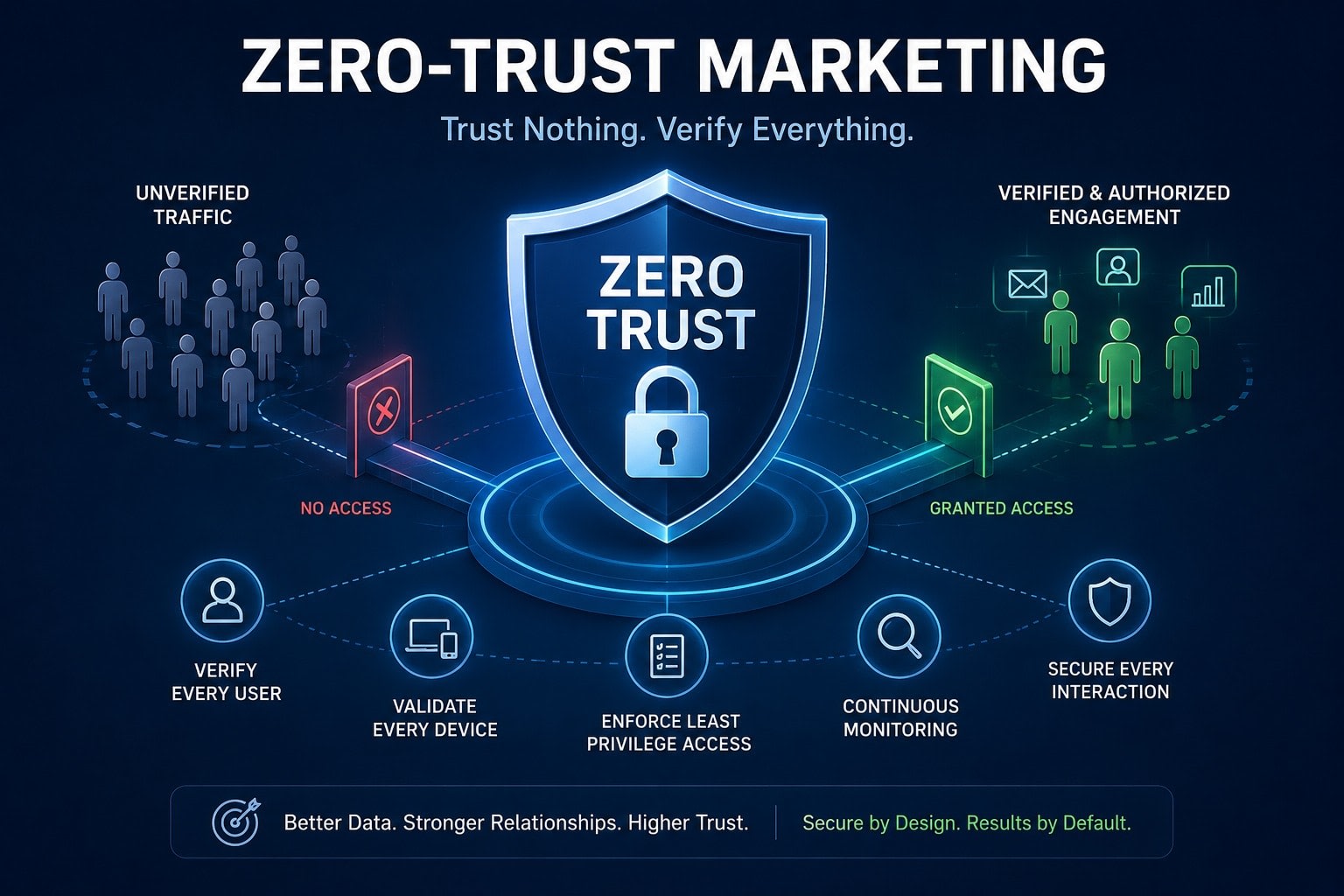
The core principles of Zero-Trust Marketing revolve around treating user data with intentional restraint, transparency, and respect.
At its foundation is data minimization, collecting only the information that is absolutely necessary for a specific purpose paired with explicit, informed consent that ensures users knowingly agree to share their data.
Transparency plays a crucial role, as brands must clearly communicate what data is being collected, how it will be used, and how it will be protected.
This is reinforced by a strong value exchange, where users receive meaningful benefits such as relevant content, tools, or personalized experiences in return for their information.
Finally, accountability and security ensure that all collected data is responsibly managed, safeguarded against misuse, and aligned with privacy regulations.
Together, these principles shift marketing from a model of assumption and extraction to one of permission, trust, and long-term relationship building.
Let’s discuss principles here:
1. Data Minimization
Only collect what you absolutely need. Avoid unnecessary fields in forms or excessive tracking scripts. If you don’t need a phone number, don’t ask for it.
2. Explicit Consent
Consent should be clear, granular, and freely given. No pre-checked boxes. No hidden terms.
3. Transparency
Users should know:
- What data is being collected?
- Why it’s being collected?
- How it will be used?
4. Value Exchange
People are more willing to share data when they receive something valuable in return whether it’s content, tools, or personalized experiences.
5. Security and Accountability
Collected data must be securely stored and responsibly managed. Trust is fragile one breach can undo years of brand building.
How Zero-Trust Marketing Transforms Lead Capture?

Traditional lead capture often looks like this:
- Long forms
- Hidden tracking
- Generic lead magnets
- Bulk email follow-ups
Zero-Trust Marketing replaces this with a more thoughtful approach:
a. Progressive Profiling
Instead of asking for everything upfront, collect data gradually over time. Start with just an email address, then build the profile through interactions.
b. Contextual Data Collection
Capture data based on user intent. For example:
- A pricing page visitor may be willing to share company size
- A blog reader may only want to subscribe to a newsletter
c. Consent-Driven Touchpoints
Every interaction becomes an opportunity to reinforce trust:
- Clear opt-ins
- Transparent messaging
- Easy opt-outs
Privacy-First Lead Capture Strategies
1. Simplify Your Forms
Shorter forms convert better and respect user privacy. Focus on essential fields:
- Name (optional in some cases)
- Email address
Use progressive profiling to gather more details later.
2. Build High-Value Lead Magnets
Offer something genuinely useful:
- In-depth guides
- Templates
- Tools or calculators
- Industry reports
The key is to make the value obvious and immediate.
3. Use First-Party Data Effectively
First-party data information users willingly share is the foundation of Zero-Trust Marketing. Leverage it to:
- Personalize content
- Improve targeting
- Enhance user experience
4. Implement Consent Management
Give users control over their data preferences:
- Cookie consent banners
- Preference centers
- Easy unsubscribe options
5. Focus on Contextual Personalization
Instead of tracking users across the web, personalize based on:
- Current session behavior
- Page context
- Declared preferences
This approach is both effective and privacy-friendly.
The Role of Content in Privacy-First Lead Capture

Content becomes even more critical in a zero-trust environment. Since you can’t rely on aggressive tracking, your content must do the heavy lifting.
Some of the roles are discussed here:
1. Educational Content
Blogs, whitepapers, and guides help build credibility and attract high-intent users.
2. Interactive Content
Quizzes, assessments, and tools encourage engagement and voluntary data sharing.
3. Thought Leadership
Position your brand as an authority. When users trust your expertise, they’re more likely to share their information.
Technology Enablers of Zero-Trust Marketing
Technology plays a critical role in enabling Zero-Trust Marketing by providing the infrastructure needed to collect, manage, and activate data in a privacy-first way.
Tools such as Customer Data Platforms (CDPs) allow businesses to unify and organize first-party data while maintaining strict governance and user consent.
Consent Management Platforms (CMPs) ensure that data collection aligns with regulatory requirements by giving users clear control over what they share and how it is used.
Additionally, privacy-first analytics tools focus on aggregated, anonymized insights rather than individual tracking, helping marketers understand performance without compromising user privacy.
Together, these technologies empower brands to build transparent, secure, and compliant data ecosystems that support trust-driven lead generation.
Read more on: How to Build a Marketing Strategy (Beginner → Practical Guide)
Let’s discuss some technologies here:
1. Customer Data Platforms (CDPs)
CDPs help unify first-party data while maintaining compliance and transparency.
2. Consent Management Platforms (CMPs)
These tools manage user consent and ensure regulatory compliance.
3. Privacy-First Analytics Tools
Unlike traditional analytics platforms, these tools:
- Avoid invasive tracking
- Focus on aggregated data
- Respect user anonymity
Challenges in Adopting Zero-Trust Marketing
Adopting Zero-Trust Marketing comes with several practical and strategic challenges, especially for organizations accustomed to data-heavy, tracking-driven approaches.
One of the primary hurdles is the reduction in readily available data, as privacy-first practices limit passive data collection and require explicit user consent, which can initially impact targeting and campaign performance.
Additionally, there is a significant cultural shift involved, marketing teams must move away from a “collect everything” mindset to a more disciplined, value-driven approach focused on trust and transparency.
Implementing new technologies such as consent management platforms and restructuring data infrastructure can also demand time, budget, and technical expertise.
Moreover, measuring campaign effectiveness becomes more complex without third-party cookies, forcing marketers to rely on first-party data, predictive modeling, and alternative attribution methods.
Despite these challenges, organizations that successfully navigate this transition often benefit from higher-quality leads, stronger customer relationships, and long-term brand credibility.
Some challenges are discussed below:
1. Reduced Data Volume
Collecting less data may feel limiting, but the quality of data improves significantly.
2. Cultural Shift
Teams must move from a data-hoarding mindset to a value-driven approach.
3. Measurement Complexity
Without third-party tracking, attribution becomes more challenging. Marketers must rely on:
- First-party analytics
- Modeled insights
- Direct feedback
Benefits of Privacy-First Lead Capture
Privacy-first lead capture offers a range of strategic advantages that go beyond compliance. By prioritizing transparency and user consent, businesses attract higher-quality leads who are genuinely interested and more likely to engage or convert.
It also strengthens brand trust, as users feel respected and in control of their data, fostering long-term relationships and loyalty.
Additionally, this approach reduces legal and regulatory risks by aligning with global data protection standards, while improving data accuracy since the information is willingly and truthfully provided.
Ultimately, privacy-first lead capture creates a more sustainable and ethical marketing ecosystem where trust, relevance, and value drive better business outcomes.
Some of the benefits are as:
1. Higher Quality Leads
Users who willingly share data are more engaged and more likely to convert.
2. Stronger Brand Trust
Transparency builds credibility and long-term relationships.
3. Regulatory Compliance
Avoid legal risks and penalties by aligning with global standards.
4. Sustainable Growth
Zero-Trust Marketing creates a foundation for long-term, ethical growth.
Real-World Use Cases
- Real-world use cases of Zero-Trust Marketing and privacy-first lead capture can be seen across industries where trust and transparency directly impact conversions.
- In SaaS, companies often offer free tools or limited trials in exchange for just an email address, gradually collecting more information through in-product interactions and user preferences.
- E-commerce brands implement preference centers that allow customers to voluntarily share interests, enabling personalized recommendations without invasive tracking.
- In B2B marketing, organizations rely on high-value gated content such as whitepapers, webinars, and industry reports, where users knowingly exchange their data for insights.
- Even in healthcare and finance, where data sensitivity is critical, brands use secure, consent-driven forms and clearly communicate how information will be used.
- Across all these scenarios, the common thread is a transparent value exchange where users understand what they are giving and what they receive in return, resulting in higher-quality leads and stronger long-term relationships.
The Future of Lead Generation
The future is not about collecting more data, it’s about earning it.
As AI, automation, and personalization evolve, the brands that succeed will be those that:
- Respect user boundaries
- Prioritize transparency
- Deliver real value
Zero-Trust Marketing isn’t just a trend, it’s the new standard.
Conclusion
Zero-Trust Marketing isn’t just a trend, it’s the future of sustainable, high-impact lead generation. As privacy expectations continue to rise, brands that prioritize transparency and user control will stand out and win long-term loyalty.
Privacy-first lead capture doesn’t limit your growth; it sharpens it. When your audience chooses to engage and share their data, every interaction becomes more intentional, more valuable, and far more likely to convert.
Now is the time to rethink your strategy. Start building trust-driven experiences, adopt privacy-first tools, and empower your audience to engage on their own terms.
Because in today’s world, the brands that earn trust are the ones that earn results.
Ready to transform your lead generation strategy?
Start implementing Zero-Trust Marketing today and turn trust into your most powerful growth engine.